SSVEC Provides Early Notice of Upcoming Streamlined Rate Case
Sulphur Springs Valley Electric Cooperative (SSVEC) is informing members that its current financial forecasts indicate a rate increase will be necessary, absent significant economic development that strengthens electric sales. Rising operating costs and electricity sales that have not kept pace with those rising costs are driving the outlook.
SSVEC anticipates filing a streamlined rate case with the Arizona Corporation Commission (ACC) in fall 2027, using 2026 as the test year for its Cost-of-Service Study. Because that study has not yet been completed, no specific rate adjustment or impact to individual member classes has been determined.
SSVEC continues to experience higher costs for many of the materials, equipment and services necessary to operate and maintain the electric system. Inflation has increased the cost of everything from poles, transformers and other electrical equipment to vehicles, technology, insurance and contracted services. At the same time, SSVEC must continue investing in aging infrastructure, system maintenance and improvements, reliability, safety, cybersecurity and the workforce needed to serve members across its service territory. These increasing costs, combined with slow economic growth and kilowatt-hour sales that have not kept pace with rising costs, place additional pressure on the cooperative’s ability to recover the cost of providing electric service through existing rates.
Significant economic development and new electric sales could improve that financial outlook. Because many of the cooperative’s costs are necessary to maintain the electric system regardless of the amount of electricity sold, meaningful growth in electric sales can help spread those costs across a larger sales base. If sufficient new electric load develops, it could reduce or delay the need for a future rate adjustment. SSVEC will continue evaluating its financial forecast as economic conditions and electric sales change.
The need for another rate review relatively soon after SSVEC’s most recent rate case was anticipated and communicated during that process. Since the previous rate case, energy sales and revenue have also moderated from the unusually high levels experienced during the 2023 test year. These changing conditions further demonstrate the importance of reviewing rates more regularly so they continue to reflect the cooperative’s actual cost of providing service.
During the previous rate case and in member discussions since, SSVEC has communicated its intention to move toward more frequent rate reviews rather than allowing many years to pass between adjustments. Member feedback also indicated a preference for smaller, more frequent adjustments rather than waiting longer periods that can result in the need for larger increases.
More frequent rate reviews may also allow SSVEC to utilize a streamlined rate case process when appropriate. Streamlined cases can reduce the regulatory time and expense associated with a traditional rate case, helping reduce costs ultimately borne by the cooperative’s members.
“We want our members to hear about this process from us early, well before any specific rate changes are proposed,” said SSVEC Chief Executive Officer Jason Bowling. “Our financial forecast shows that another rate adjustment will likely be necessary under current conditions. At the same time, meaningful economic development and growth in electric sales could improve that outlook. That’s why we will continue evaluating our financial needs as we complete the Cost-of-Service Study and move through this process.”
Final 2026 financial information is expected to be available in spring 2027. SSVEC will then complete its Cost-of-Service Study using 2026 financial and operating information to determine the cooperative’s revenue requirements and evaluate how the costs of providing service should be allocated among SSVEC’s different member classes.
Based on the cooperative’s current timeline, SSVEC anticipates being prepared to file a streamlined rate case with the ACC in fall 2027. That timeline is preliminary and may change as the Cost-of-Service Study and other required work progress. Any proposed rate changes would be subject to ACC review and approval.
“As a member-owned, not-for-profit cooperative, our responsibility is to collect the revenue necessary to provide safe and reliable electric service while keeping rates as affordable as possible,” Bowling said. “We have a responsibility to plan ahead financially, but we also have a responsibility to be transparent with our members. That is why we are beginning this conversation now rather than waiting until a rate proposal is ready to file.”
SSVEC will provide additional information to members as the Cost-of-Service Study progresses. Once the study is complete, the cooperative will share details regarding any proposed rate changes, impacts to individual rate classes, the regulatory process and opportunities for members to learn more and provide input.
Updates will be provided through SSVEC’s website, Currents, member communications, public meetings and other outreach channels.


Principle In Action
How the 7 Cooperative Principles Work for You
You may often hear that SSVEC is a cooperative, but what does that mean for you? Unlike an investor-owned utility, SSVEC is a not-for-profit business owned by the members it serves—and you have a voice through elected board representatives. Cooperatives bring people together to meet shared needs through a business they own and democratically control. Across industries and around the world, cooperatives share seven guiding principles that turn values such as fairness, responsibility, and caring for others into action. Cooperatives trace the roots of these principles to the first modern cooperative founded in Rochdale, England in 1844. These principles are a key reason that America’s electric cooperatives operate differently from other electric utilities.
PRINCIPLE IN ACTION
Foundation distributes grants to 178 local teachers

The SSVEC Foundation is awarding $150,000 in microgrants to teachers across the Sulphur Springs Valley Electric Cooperative service territory, helping fund classroom projects, supplies and equipment at schools throughout the region.
The grants will support 178 teachers at 31 schools. Individual awards of up to $999 were delivered to campuses last week.
Kristin Gray, SSVEC Community Relations Manager, said the program is designed to help educators bring classroom ideas to life and cover needs that might otherwise go unfunded.
“This is the culmination of an intensive application process that helps teachers achieve their classroom goals,” Gray said.
The grants are funded through unclaimed Member Equity payments and community donations. As a cooperative, SSVEC periodically returns margins to members through Member Equity distributions. If former members move out of the area and cannot be located after repeated attempts, those unclaimed funds are transferred to the SSVEC Foundation.
Randy Redmond, president of the SSVEC Board of Directors, said it is important for members to know the grants are not funded through electric rates.

“It’s important that our members understand that the funding for these Foundation grants is not in any way related to what our members pay for their electricity,” Redmond said. “This is money generated from unclaimed Member Equity, and the mission of the Foundation is to return those funds back to the community.”
Jason Bowling, SSVEC chief executive officer, said the teacher microgrants expand the Foundation’s broader commitment to youth and education.
“The SSVEC Foundation currently sponsors the Washington Youth Tour, the Youth Engineering and Science Fair, and provides a total of 40 scholarships to the best and brightest graduating seniors for trade programs and higher education,” Bowling said. “We’re confident that these microgrants will make a difference in the education of our youth and thereby will improve the quality of life in the communities we serve.”
Photo captions: (from left) Agueda Guerrero, SSVEC Accounting Specialist, Kristin Gray, Community Relations Manager and Hannah Oldfield, Intern, get ready to distribute $150,000 in grants awarded by the SSVEC Foundation.
A full basket of checks that will be distributed to 178 teachers at 31 schools in the SSVEC service territory.
BEHIND THE METER
NEW LARGE-LOAD REVIEW PROCESS PROTECTS SSVEC MEMBERS
The Arizona Corporation Commission-approved process provides a framework for evaluating large energy projects while protecting existing Members.
From time to time, a large business may consider locating within Sulphur Springs Valley Electric Cooperative’s service territory. This could include a manufacturing facility, processing plant, data center, mining operation or another business that uses a significant amount of electricity.
When that happens, Members naturally have questions: Will this affect my electric rates? Will existing Members have to pay for new power lines or substations? Could serving a large business affect the reliability of electric service?
These are important questions, and Members deserve clear answers.

What Did the Commission Approve?
On August 12, 2026, the Arizona Corporation Commission approved a process for reviewing future electric service agreements involving large energy users.
SSVEC requested approval of this process along with Arizona Electric Power Cooperative (AEPCO) and four other Arizona electric cooperatives. The cooperatives developed the process in response to growing interest from businesses that may require unusually large amounts of electricity.
It is important to understand what the Commission’s decision does and does not mean. The Commission approved a review process. It did not approve a particular business, construction project, electric rate or large-load service agreement. Each future project must be evaluated individually.
Why Is a Special Review Needed?
Providing electric service to a home or small business can often be handled through SSVEC’s existing system and standard terms of service. A very large energy user can be different.
Depending on the project’s size and location, serving it could require new power lines or substations, additional transmission capacity, distribution system improvements, new sources of power, special billing arrangements or financial guarantees.
Because AEPCO provides SSVEC with wholesale power, it must also be involved in planning for a very large new electric load. SSVEC, AEPCO and the business may therefore need to enter into a multi-party electric service agreement. The new process establishes how those agreements will be presented to and reviewed by the Arizona Corporation Commission.
How Will SSVEC Members Be Protected?
The central protection in the approved process is simple: existing Members and other groups of electric customers should not have to subsidize a large business’s commercial activities.
Before an agreement can receive Commission approval, the filing must explain how the project will be served, what facilities will be needed and how the associated costs will be handled.
The filing must also describe the financial protections included in the agreement. Depending on the project, those protections could include upfront construction payments, financial guarantees, minimum monthly billing or demand commitments, fees if the business ends its agreement early, and advance-notice requirements if the business plans to reduce its electric needs.
These protections are important because SSVEC and AEPCO may need to build or obtain facilities specifically for a large project. If the business later uses less electricity than expected or closes, those facilities could otherwise become costs that must be recovered from other Members.
The approved process does not assume that one arrangement will work for every project. Instead, the costs, payment responsibilities and financial protections must be explained and reviewed based on the facts of each proposal.
What Will the Commission Consider?
After a multi-party agreement is approved by the cooperative’s board and signed by the parties, it will be submitted to the Arizona Corporation Commission.
The filing will provide information about the business, its expected electric use, potential community benefits, required electric facilities, construction costs, payment arrangements and financial protections. It will also explain whether the business plans to use on-site solar, energy storage or other generation, and whether its electric use can be reduced or interrupted when necessary.
Commission Staff will evaluate three primary questions:
- Is the agreement in the public interest?
- Are the proposed rates reasonable?
- Does the agreement prevent other customers from subsidizing the large business?
Commission Staff may request additional information and conduct further analysis before making a recommendation. Approval of an agreement also does not guarantee how its costs or revenues will be treated in future rate decisions.
Could a Large Business Benefit SSVEC Members?
A responsibly managed large load can create opportunities for the cooperative and the communities we serve.
Electric cooperatives have fixed costs associated with maintaining power lines, substations, equipment and other parts of the electric system. Adding significant new energy sales can allow some of those fixed costs to be spread across more kilowatt-hours.
Every project is different, and a large new load does not guarantee lower electric rates. However, responsible growth may improve how efficiently the electric system is used and could help reduce future pressure on rates.
Large businesses may also bring jobs, investment, tax revenue and other economic activity to local communities. The filing must describe the benefits the business expects to bring to the community so they can be considered as part of the Commission’s public-interest review.
Reliable Service Remains the Priority
Before SSVEC agrees to serve a large energy user, SSVEC and its power-supply partners must determine what is needed to serve the project safely and reliably.
That includes reviewing the local distribution system, transmission needs, power supply, interconnection requirements and the amount of electricity the business expects to use. If improvements are needed, those requirements and their estimated costs must be identified in the agreement and presented to the Commission.
Protecting the affordability and reliability of electric service for existing Members remains a priority throughout the process.
Our Commitment to Members
SSVEC does not decide whether a particular business should locate in one of our communities. Our responsibility is to determine whether and how electric service can be provided safely and reliably under applicable service requirements and on terms that protect existing Members.
The Commission-approved process gives SSVEC, AEPCO, prospective large energy users and the Arizona Corporation Commission a clear framework for evaluating each proposal individually.
Economic development can bring new investment and opportunity to the communities we serve. When it also brings significant new electric demand, SSVEC’s job is to make sure that growth is managed responsibly and in the best long-term interests of our Members.
Members who would like to learn more may review Arizona Corporation Commission Decision No. 82128 under Docket No. E-01773A-26-0123.
PRINCIPLE IN ACTION
Keeping Education and Preparedness Front of Mind

SSVEC’s mission is to provide safe, reliable, and affordable electric service to its members. Safety is fundamental to fulfilling that mission—both for employees working throughout the cooperative’s service territory and for members on the other side of the meter. Through continued education and hands-on experience, SSVEC works to strengthen its team and better serve the communities it calls home.
Throughout September, SSVEC will conduct Mayday Training Drills for employees across its service territory. These realistic simulations prepare employees to respond effectively during emergencies while working alongside local first responders. By recreating a variety of possible situations in a controlled environment, participants can practice communication, coordination, and critical decision-making before those skills are needed in a real emergency.
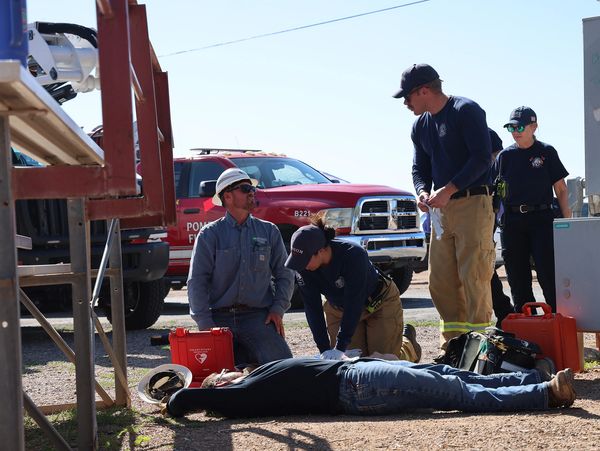
Safety Manager Matt Riesgo has been planning the exercises and coordinating with area emergency-response partners in preparation for this annual training. In previous years, participating agencies have included local police, ambulance services and fire departments, Air Evac, the Cochise County Sheriff’s Office, and SEACOM 911.
These exercises help strengthen teamwork, identify opportunities for improvement, and offer employees valuable experience in a safe and structured setting. They also allow SSVEC and local first responders to become more familiar with one another’s procedures, helping them work together more effectively when every second counts.
Although members may never see this preparation taking place, the skills and partnerships developed through these annual drills support the safe, dependable service you rely on every day. By keeping safety education and preparedness front of mind, SSVEC remains ready to respond when the unexpected occurs.
Behind The meter
SSVEC Supports Local Students Through Back-to-School Events
Electric cooperatives are more than power providers—they are member-owned, not-for-profit organizations built to serve the people and communities they call home. Around the world, cooperatives operate according to seven guiding principles established by the International Cooperative Alliance (ICA). These principles emphasize democratic member control, education, cooperation among cooperatives, and a commitment to improving the quality of life for the communities they serve.
At Sulphur Springs Valley Electric Cooperative (SSVEC), these principles are more than a foundation—they shape the way we do business every day. One principle that is especially meaningful is Concern for Community, which reflects our commitment to supporting local students, families, schools, and organizations through volunteerism, partnerships, and community involvement.
As summer break comes to an end, students across our service territory are preparing for a new school year, and SSVEC is proud to help them start off on the right foot.
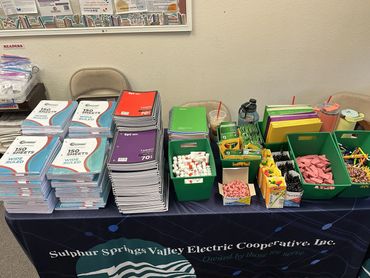
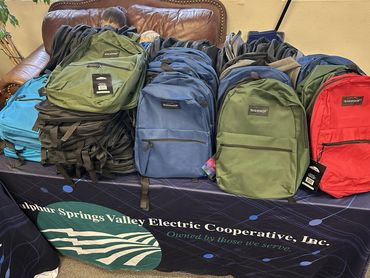
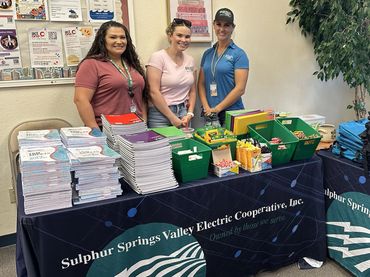
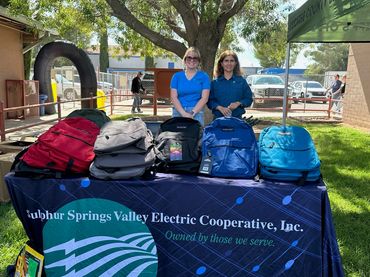
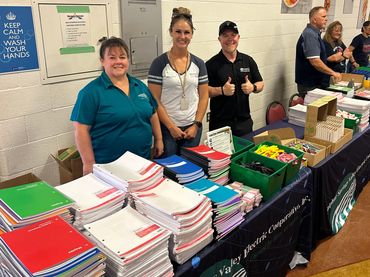
In late July, SSVEC employees volunteered at local Back-to-School events hosted by Benson Schools, the Huachuca City Library, and Elfrida Elementary School. These events provided essential school supplies to students in grades K–12, giving them tools they need for a successful start to the school year. Donations included backpacks filled with notebooks, folders, paper, pens, pencils, highlighters, colored pencils, graph paper, erasers, and other classroom essentials.
Supporting these events is one of the many ways SSVEC puts the cooperative principles into action. By partnering with local schools and investing in the success of students, the cooperative helps build stronger communities today while supporting the leaders of tomorrow. It is a reflection of who we are as a cooperative—neighbors working together to create a brighter future.
Rep. Ciscomani recognizes SSVEC national award
Hailing the commitment of the Sulphur Springs Valley Electric Cooperative (SSVEC) for prioritizing affordability, Congressman Juan Ciscomani celebrated the national award received by the local utility in a speech to Congress.
"Mr. Speaker, I rise today to congratulate Sulphur Springs Valley Electric Cooperative in southern Arizona for receiving the 2026 Electric Cooperative Purpose Award from the National Rural Electric Cooperative Association," Ciscomani stated in his remarks from the floor of the House of Representatives.
SSVEC recently received the Electric Cooperative Purpose Award from the National Rural Electric Cooperative Association (NRECA). The award recognizes cooperatives that work with their membership to make visible, lasting improvements to the quality of life in the communities they serve. SSVEC earned the recognition for actions taken during the 2022 surge in global fuel prices that placed significant pressure on energy costs for rural families and businesses.
"I congratulate the Board of Directors, the employees, and the member-owners of Sulphur Springs Valley Electric Cooperative," Rep. Ciscomani said. "Thank you for your commitment to protecting affordability and serving rural Arizona."
SSVEC’s board and leadership team implemented a member-focused strategy during the surge in global fuel prices designed to deliver immediate relief while maintaining long-term financial stability. The cooperative directed 100 percent of its annual operating margin to buy down more than $8 million in member fuel bank debt, reducing the wholesale power and fuel cost adjuster and lowering the cost burden on the cooperative’s member-owners.
"SSVEC’s board and leadership team knew they needed to protect the very members who own the cooperative while maintaining long-term stability — and that’s exactly what they did," Ciscomani said. "They responded with ingenuity and resolve, launching direct communication with members, working with its cooperative partner, AEPCO, to establish a fuel hedging program, and directing 100 percent of its annual operating margin to buy down more than $8 million in member fuel bank debt."
SSVEC was recognized for the award during NRECA’s Power Xchange national meeting, held March 6 to March 11 in Nashville, Tenn., where electric cooperative leaders from across the country gather to share best practices and celebrate achievements within the cooperative network.
A video of Rep. Ciscomani's remarks from the floor of the House of Representatives is available online at www.youtube.com/watch?reload=9&v=OTNUT1CSWzs.


SSVEC Receives National Electric Cooperative Purpose Award
Willcox, AZ — Sulphur Springs Valley Electric Cooperative (SSVEC) has been recognized with the 2026 Electric Cooperative Purpose Award by the National Rural Electric Cooperative Association (NRECA), honoring the cooperative’s commitment to its members and communities during a period of unprecedented energy cost volatility.
The Electric Cooperative Purpose Award recognizes cooperatives that work with their membership to make visible, lasting improvements to quality of life in the communities they serve. SSVEC earned the recognition for actions taken during the 2022 surge in global fuel prices that placed significant pressure on energy costs for rural families and businesses.
During that period, SSVEC’s board and leadership team implemented a member-focused strategy designed to deliver immediate relief while maintaining long-term financial stability for the cooperative. The cooperative directed 100 percent of its annual operating margin to buy down more than $8 million in member fuel bank debt, reducing the wholesale power and fuel cost adjuster and lowering the cost burden on the cooperative’s member-owners.
“This recognition reflects what cooperatives are built to do,” said Jason Bowling, Chief Executive Officer of SSVEC. “When our members were facing rising energy costs, our board, employees, and cooperative partners worked together to find a solution that delivered immediate relief while protecting the long-term strength of the cooperative.”
The effort required collaboration across the cooperative network. SSVEC worked closely with its power supply partner, the Arizona Electric Power Cooperative (AEPCO), along with financial partners, regulators, and cooperative peers to implement a strategy that balanced affordability with long-term resilience.
Employees across the organization played a key role in evaluating options, coordinating with partners, communicating with members, and implementing the financial and operational changes needed to execute the plan.
Bowling noted that while the award recognizes past action, cost pressures in the electric industry continue to affect utilities and their members nationwide.
“Electric cooperatives across the country are facing rising costs for power supply, infrastructure, and reliability,” Bowling said. “Our members have seen that pressure recently, and we understand the concern that comes with it. What this recognition represents is our commitment to confront those challenges directly. In every creative way we can muster, we will work to shield our members from volatility while maintaining the safe and reliable service they depend on.”
Because of the steps taken in recent years, SSVEC has strengthened its financial position and improved its ability to manage future energy market volatility while continuing to serve more than 50,000 members across Cochise, Graham, and Pima counties.
“The cooperative model works because decisions stay close to the people they affect,” Bowling said. “This award recognizes the trust our members place in us and the dedication of employees who work every day to protect affordability and reliability for the communities we serve.”
SSVEC was recognized for the award during NRECA’s Power Xchange national meeting, where electric cooperative leaders from across the country gather to share best practices and celebrate achievements within the cooperative network.
Sulphur Springs Valley Electric Cooperative is a member-owned electric cooperative headquartered in Willcox, Arizona, providing safe, reliable, and affordable electricity to communities across southeastern Arizona.